Gralén, K, Carlsson H, Lindgren P
Cancervården under press – ökad överlevnad ställer nya krav
The report is written in Swedish with a summary in English
Swedish cancer care is undergoing a paradigm shift, driven by rising number of new cancer cases, improved survival rates and advances in medical technology, creating new demands on healthcare capacity, workforce sustainability and long-term planning. In this report, we examine the challenges that Swedish cancer care faces as patterns of care demand continue to change.
Cancer care in Sweden is undergoing a profound structural transformation. The number of new cancer cases has increased significantly over recent decades and is expected to continue rising as a result of an ageing population, improved diagnostics and expanded screening programs. At the same time, advances in precision medicine, immunotherapies and other innovative treatments have contributed to improved survival rates and longer life expectancy for people living with cancer.
This development means that increasing numbers of individuals are living for longer with a cancer diagnosis or following treatment. The number of people living with cancer (5-year prevalence) increased by 77 percent between 2000 and 2023, rising from 120,377 to 212,913 individuals. As a result, the focus of cancer care is gradually shifting from a model dominated by acute interventions towards a healthcare system in which long-term treatment and follow-up care play an increasingly important role.
This trend illustrates a fundamental system-wide challenge in modern healthcare. While medical advances improve patient outcomes, they also contribute to growing care volumes and increasingly complex patient pathways. Contemporary cancer treatment often involves advanced diagnostics, multiple lines of therapy and continuous monitoring, increasing resource requirements across the entire care continuum.
At the same time, national care programs and standardized cancer care pathways have strengthened the foundations for more equitable care and greater consistency in patient management. However, these reforms have also contributed to increased demand for diagnostics and treatment, further intensifying pressures on capacity and resource utilization.
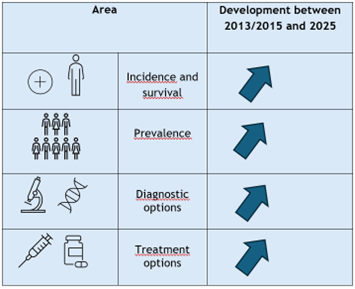
Overview of developments in Swedish cancer care as a result of more cancer cases, changes in national care programs and medical technology advances
A critical factor in meeting future demand for cancer care is healthcare skills supply. The availability of specialist expertise in areas such as oncology, pathology, radiology and cancer nursing has not expanded at the same pace as care needs. The ability to recruit, develop and retain highly skilled professionals will therefore be essential to maintaining the quality, accessibility and long-term sustainability of cancer care.
All together, these developments point towards a healthcare system in which a growing patient population is living longer with cancer and with increasingly complex care needs. This places greater emphasis on strategic planning and a comprehensive approach, where diagnostics, treatment, follow-up care and workforce capacity are viewed as interdependent components of the same system. Meeting future needs will require long-term priorities and sustainable resource allocation to ensure that cancer care remains accessible, equitable and of high quality in the years ahead.
For more information, please contact Katarina Gralén
IHE RAPPORT 2026:7, IHE: Lund
Cite: Gralén K, Carlsson H, Lindgren P. Cancervården under press – ökad överlevnad ställer nya krav. IHE RAPPORT 2026:7, IHE: Lund.